

When it comes to the best candy bars, few decades can compete with the 1980s. For Gen X kids, candy bars weren’t just snacks, they were oftentimes entire meals and cultural identifiers. Whether you grabbed one from a convenience store after school or found it waiting in your lunchbox, each bite was filled with sugar and remains in our memories as a symbol of simpler, sweeter times.
While many classic candy bars of the ’80s are still around today: Snickers, Milky Way, and Reese’s, some truly memorable creations were born in that decade, while others sadly disappeared forever. The 1980s were a golden age for candy innovation and experimentation, and some of the best candy bars from that era still spark nostalgia today.
Candy Bars Born in the 80s
Cow Tales (Introduced in 1984)
Few treats captured the whimsical fun of the 1980s quite like Cow Tales. Launched by Goetze’s Candy Company in 1984, Cow Tales weren’t exactly a traditional “bar” in shape, but they earned their place among the best candy bars of the decade. The caramel outside and creamy vanilla center made them chewy, sweet, and delightfully different. They were portable, fun to eat, and the packaging included a cartoon cow. They tasted like they were filled with pure ’80s charm.
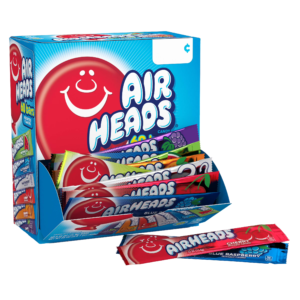
Airheads (Introduced in 1986)
By the mid-1980s, candy companies were competing for attention from kids obsessed with color, texture, and flavor expansions. Enter Airheads, the stretchy, chewy, and tangy candy that hit U.S. stores in 1986. Created by Perfetti Van Melle, Airheads quickly became a lunchroom currency—traded, swapped, and shared by kids across America.
Though not a chocolate bar, Airheads embodied the adventurous candy spirit of the decade. They came in wild flavors like Cherry, Blue Raspberry, and Watermelon, and their soft, moldable texture made them fun to play with before eating. For those who grew up in the ’80s, Airheads weren’t just candy—they were an interactive experience.
Symphony Bar (Introduced in 1989)
Just when you thought chocolate couldn’t get any smoother, Hershey’s dropped a game-changer. In 1989, the Symphony Bar hit the market, offering a more refined take on milk chocolate. It was creamier, richer, and targeted adults with its “symphony” of flavors and textures.
The classic Symphony Bar came in two varieties: plain milk chocolate, and the more popular milk chocolate with almonds and toffee chips. The latter delivered a crisp, buttery crunch that elevated it to one of the best candy bars of its time. It stood apart from its rowdier candy-aisle neighbors, giving chocolate lovers something a little more sophisticated.
Skor (Introduced in 1981)
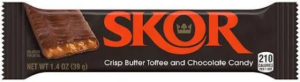
If Symphony was the smooth and sophisticated hit of the late decade, Skor was a bold and crunchy newcomer. Introduced by Hershey’s in 1981, Skor was a direct response to the success of the Heath Bar—but with a sleeker, more upscale design. Its thin layer of buttery toffee enrobed in dark milk chocolate gave it a nice crunch and a satisfyingly rich taste.
Skor’s black wrapper with the red logo looked like something from a rock concert rather than a candy shelf. Like the Symphony Bar, it appealed to the “grown-up” candy eater while still fitting in perfectly with the wild, indulgent vibe of the ’80s.
The Best Candy Bars and A Lot More
For Gen X food, the 1980s didn’t just revolutionize candy bars, the decade also gave birth to some of the most iconic non-chocolate candies of all time. In 1983, Nerds burst onto the scene, created by Willy Wonka Candy Company (then a division of Sunmark Corporation). Packaged in a clever split box that let you mix or separate flavors like grape and strawberry, Nerds were pure ’80s energy—bright, tangy, and unapologetically fun.
A year later, Sour Patch Kids hit U.S. shelves after originating in Canada under the name “Mars Men.” Their sour-then-sweet flavor was unlike anything else at the time, quickly making them a favorite for kids who liked a little adventure in every bite. The candy world was changing fast, and these new arrivals reflected the decade’s love of color, creativity, and edge.
Another unforgettable addition was Big League Chew, which debuted in 1980 and instantly became a Little League dugout favorite. Invented by former baseball player Rob Nelson and Portland Mavericks pitcher Jim Bouton, Big League Chew took the form of shredded bubble gum packed in a pouch—cleverly designed to mimic chewing tobacco without any of the bad habits. Its wacky idea and bold packaging captured the spirit of the decade: rebellious, playful, and a little over the top. Together, Nerds, Sour Patch Kids, and Big League Chew didn’t just satisfy America’s sweet tooth—they reshaped candy culture entirely, ushering in a new era where the wildest ideas could become nationwide obsessions.
The 80’s Giveth and the 80’s Taketh Away: The Best Candy Bars We Lost
As much as the ’80s gave us new favorites, it also took away a few beloved classics. Candy bars that had been part of the American food landscape for years suddenly vanished, leaving fans with only memories, and maybe a few old wrappers tucked away in desk drawers.
The Reggie Bar
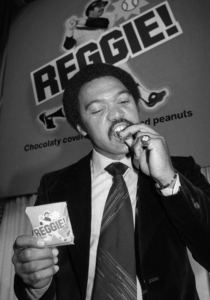
Named after Mr. October, baseball legend Reggie Jackson, the Reggie Bar was a phenomenon when it launched in the late 70s. Distributed by the Standard Brands company (and later by Curtiss), it was a round patty of peanuts, caramel, and chocolate—essentially a cross between a Snickers and a Payday. When Reggie Jackson hit his 563rd home run, Yankee fans threw thousands of Reggie Bars onto the field in celebration.
But as the ’80s progressed, sales dwindled, and the Reggie Bar was discontinued by the mid-decade. Unfortunately, attempts to bring it back never caught on. Still, for those who remember it, the Reggie Bar was one of the best candy bars of the time period and probably the best one to ever be associated with a sports hero—sweet, chewy, and packed with personality.
The Summit Bar
Launched by Mars in 1978, the Summit Bar was an ambitious experiment in texture. It featured two wafers layered with peanuts and covered in milk chocolate. It was deliciously light and crispy, with a taste somewhere between a Twix and a Nutty Buddy. Unfortunately, the delicate wafers didn’t hold up well in shipping or storage, often breaking apart before they reached store shelves.
Mars tried to repackage it in the early 1980s with a more durable chocolate coating, but it never quite gained traction. By 1984, the Summit Bar had melted into history.
The Powerhouse Bar
The Powerhouse Bar had a much longer history; it was originally created in the 1930s by the Hollywood Candy Company. But by the 60’s, Peter Paul’s candy company supplied the version Gen X grew up with. It was a chunky, dense bar filled with fudge, caramel, peanuts, and a heavy chocolate coating.
The Powerhouse Bar was discontinued in the early 1980s, ending a nearly 50-year run. For some older Gen Xers, losing the Powerhouse Bar was like saying goodbye to a piece of childhood itself—a reminder that even the best candy bars can’t always survive changing tastes and times.
A Legacy Wrapped in Foil
Looking back, the 1980s was a candy lover’s playground. The decade introduced us to new sensations like Cow Tales, Airheads, Nerds, Sour Patch Kids, Symphony, and Skor—each a reflection of its time. It also said farewell to classics like the Reggie Bar, Summit, and Powerhouse.
For those who grew up in that sugar-coated decade, the best candy bars weren’t just about flavor, they were about freedom, youth, and fun. Every wrapper told a story. Every bite took you to a moment when life was simpler, music was louder, and the candy aisle seemed like a world of endless adventure.